Why API-First Matters
Traditional monolithic architectures create invisible walls. Each feature addition requires touching multiple systems. Integration becomes a bottleneck. Innovation slows to the pace of your slowest dependency.
API-first architecture inverts this. Instead of building features directly into applications, you build capabilities behind well-defined interfaces. Applications become thin orchestration layers that combine capabilities in context-appropriate ways.
The Three Core Benefits
Parallel Development: Teams can work on different services simultaneously without coordination overhead. As long as interfaces remain stable, internal implementations can evolve independently. Technology Flexibility: Each service can use the best tool for its job. Your authentication service might use one language while your data processing pipeline uses another. The interface, not the implementation, defines the contract. Exponential Recombination: With N well-designed APIs, you can build far more than N applications. Each new capability multiplies the value of existing ones through novel combinations.
Designing Effective APIs
The Contract-First Principle
Great APIs start with the contract, not the implementation. Before writing code, define what the API promises to do, what inputs it accepts, what outputs it produces, and what guarantees it makes about behavior. This discipline forces clarity. Ambiguous requirements become obvious when you try to specify them precisely. Edge cases surface during design rather than production. Contract-first thinking is specification-driven development.
Six API Design Patterns
Resource-Oriented Design: Model your API around resources (nouns) rather than actions (verbs). Resources represent business entities. Standard HTTP methods provide the verbs. This creates predictable, intuitive interfaces. Consistent Naming: Use the same terms across all APIs. If one service calls it 'userId' and another calls it 'user_id' and a third calls it 'userIdentifier', integration becomes unnecessarily complex. Standardize. Versioning Strategy: Plan for evolution from day one. APIs will change. Build versioning into your URLs or headers. Support old versions during transition periods. Breaking changes without versioning break systems. Error Handling: Errors are part of the interface. Return structured error information that enables calling systems to respond appropriately. HTTP status codes indicate categories. Response bodies provide details. Idempotency: Design operations to be safely retried. Networks fail. Requests timeout. If retrying an operation produces different results than executing it once, you create data inconsistencies. Make write operations idempotent. Documentation as Code: Generate API documentation from specifications. Tools like OpenAPI/Swagger turn machine-readable specs into human-readable docs. This ensures documentation stays synchronized with implementation.
Building for Composition
Individual APIs provide value. Composed APIs provide leverage. The real power of API-first architecture emerges when services combine to enable capabilities that no single service could provide alone.
Orchestration vs Choreography
Two patterns dominate service composition. Orchestration uses a central coordinator that calls services in sequence, managing the workflow. Choreography has services react to events without central control, each knowing its role in the larger process. Orchestration provides clarity and control. You can see the entire workflow in one place. Debugging is straightforward. But the orchestrator becomes a potential bottleneck and single point of failure. Choreography provides resilience and scalability. No single coordinator means no single bottleneck. Services scale independently. But understanding system behavior requires tracking events across multiple services. Most systems benefit from both patterns. Use orchestration for user-facing workflows where you need tight control and clear error handling. Use choreography for background processes where eventual consistency is acceptable.
The Gateway Pattern
API gateways sit between external clients and internal services. They provide a unified entry point that handles cross-cutting concerns: authentication, rate limiting, request routing, protocol translation, and response aggregation. This pattern enables evolution without breaking clients. Internal services can split, merge, or relocate. The gateway maintains the external interface while adapting to internal changes. Clients remain unaffected.
Implementation Strategies
Start Small, Think Big
Don't try to rebuild your entire system at once. Identify a capability that could benefit from extraction. Build an API around it. Test with a single client. Iterate based on learnings. Expand gradually. Good candidates for early API-fication share common characteristics: they're well-understood, have clear boundaries, provide value to multiple consumers, and don't require extensive coordination with other systems.
The Strangler Fig Pattern
When migrating from monoliths, use the strangler fig pattern. Build new capabilities as services behind APIs. Route new requests to new services. Gradually migrate old functionality. The new system slowly replaces the old one without requiring a big bang rewrite. This approach manages risk. If a new service has issues, you can route traffic back to the monolith. Each migration is independently reversible. Teams can work at different speeds on different parts of the system.
Observability from Day One
Distributed systems are harder to debug than monoliths. You need visibility into how requests flow across services, where time is spent, and where failures occur. Build observability into your APIs from the start. Every API should emit structured logs, metrics, and traces. Use correlation IDs to track requests across services. Implement health check endpoints. Monitor error rates, latency percentiles, and throughput. Make system behavior visible.
Avoiding Common Pitfalls
API-first architecture creates new opportunities and new challenges. Understanding common failure modes helps you avoid them.
The Distributed Monolith
The worst outcome is a distributed monolith: services that must deploy together, share databases, and know intimate details of each other's internals. You get all the complexity of distributed systems with none of the benefits of modularity. Avoid this by enforcing interface boundaries. Services communicate only through APIs, never through shared databases or internal implementation details. Each service owns its data. If services must deploy in lockstep, they're not truly independent.
Chatty APIs
APIs that require many round trips to accomplish simple tasks create latency and fragility. If displaying a user profile requires 15 API calls, you've designed the wrong interface granularity. Design APIs around use cases, not database tables. Provide endpoints that return the data clients actually need, even if assembling that data requires coordinating multiple internal systems. The API boundary should optimize for client convenience.
Versioning Avoidance
Some teams resist API versioning, hoping to avoid the complexity. This leads to worse outcomes: breaking changes that affect all clients simultaneously, or APIs that accumulate optional parameters until they become unmaintainable. Embrace versioning. It enables evolution without breaking existing integrations. Plan for multiple versions to coexist. Provide migration guides. Deprecate old versions gracefully. Versioning is not overhead, it's enablement.
The Path Forward
API-first architecture is not a destination, it's a practice. Your first APIs won't be perfect. That's expected. The goal is to establish patterns that enable continuous improvement.
Building API Culture
Technical patterns alone don't create great API architectures. You need organizational practices that support API thinking: design reviews focused on interface quality, documentation standards, client feedback loops, and metrics that track API effectiveness. Treat internal APIs with the same care as external ones. Your internal teams are your first customers. If internal APIs are difficult to use, complex, or poorly documented, external APIs will inherit these problems.
Measuring Success
Track metrics that indicate API health: adoption rate, error rates, latency percentiles, time to integrate, and client satisfaction. These signals tell you whether your APIs enable or impede development. The ultimate measure is velocity: how quickly can teams build new capabilities by composing existing APIs? If this accelerates over time, your API strategy is working. If it slows, investigate why. API-first architecture is an investment in future flexibility. It trades some upfront complexity for long-term adaptability. Done well, it enables organizations to respond to change faster than competitors, combine capabilities in novel ways, and scale systems without scaling complexity. Start building your composable future today.
Evolve a contract without stranding its clients
A concrete compatibility rehearsal
Consider a fictional order API returning an ID and status. A new client needs a fulfillment estimate. Adding an optional field looks harmless, but an old consumer may validate responses against a schema that rejects unknown properties. Compatibility is a property of the deployed producer-consumer pair, not the server diff alone. Capture representative old requests and expected responses as fixtures. Run them against the candidate server, then exercise the new client separately. The contract should specify absent, null, and unknown values rather than letting each consumer guess.
A compatible API transition
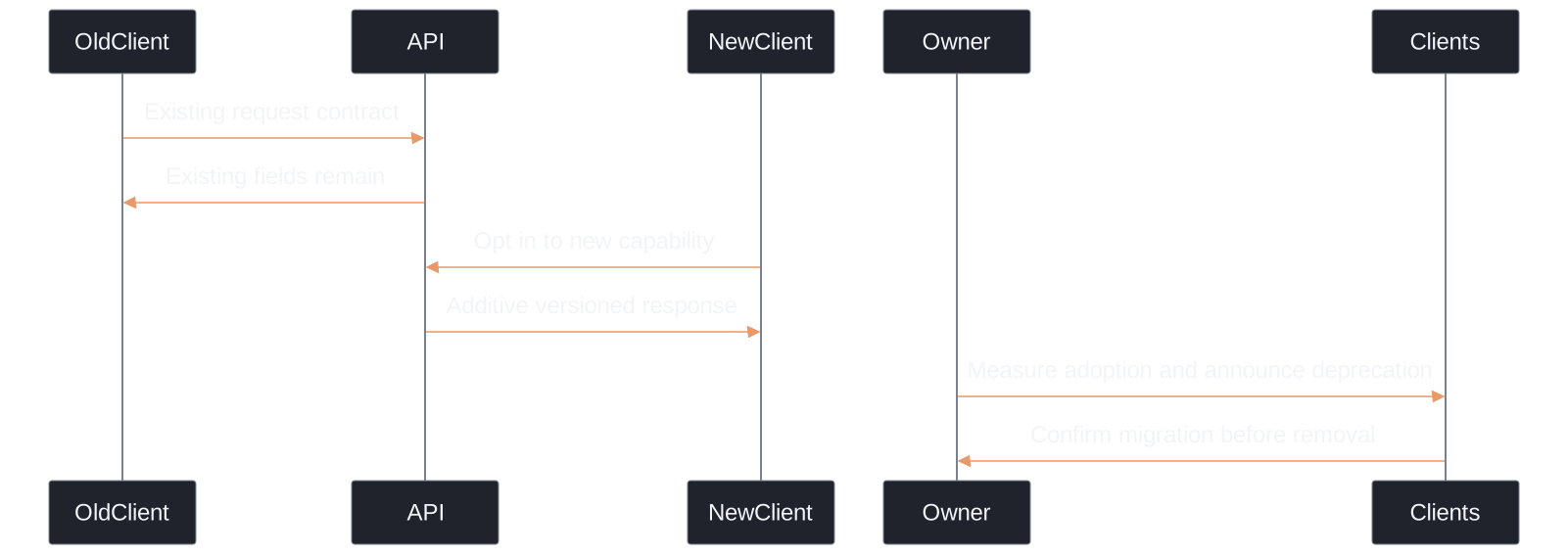
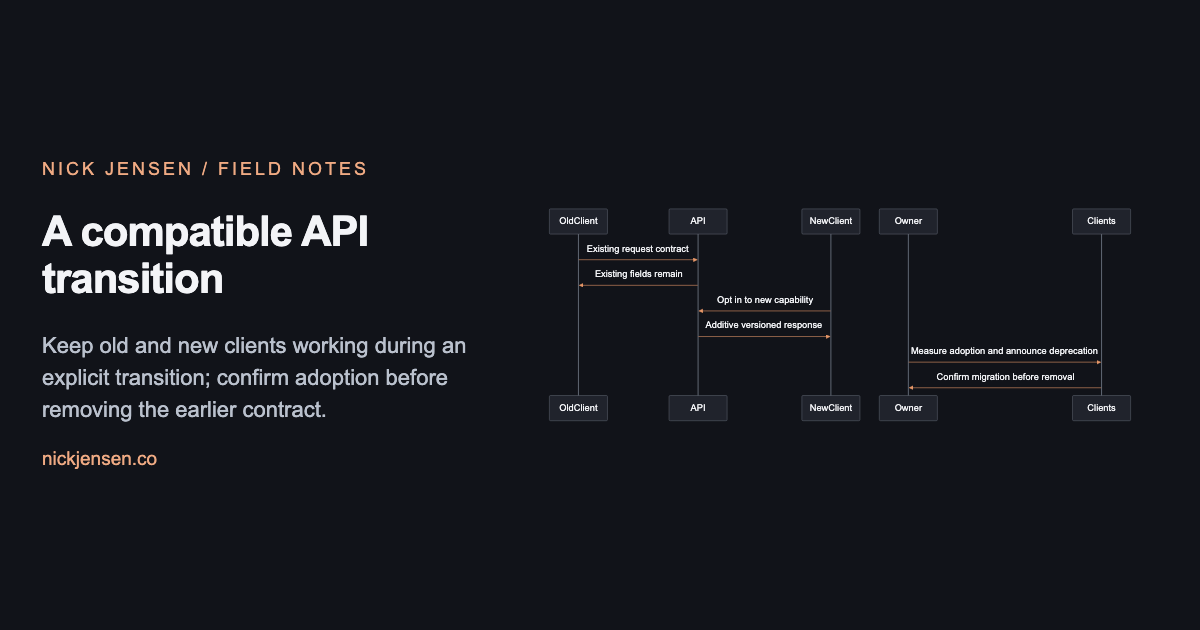
Keep old and new clients working during an explicit transition; confirm adoption before removing the earlier contract.
Illustrative framework · Graphic by Nick JensenRead the diagram as text
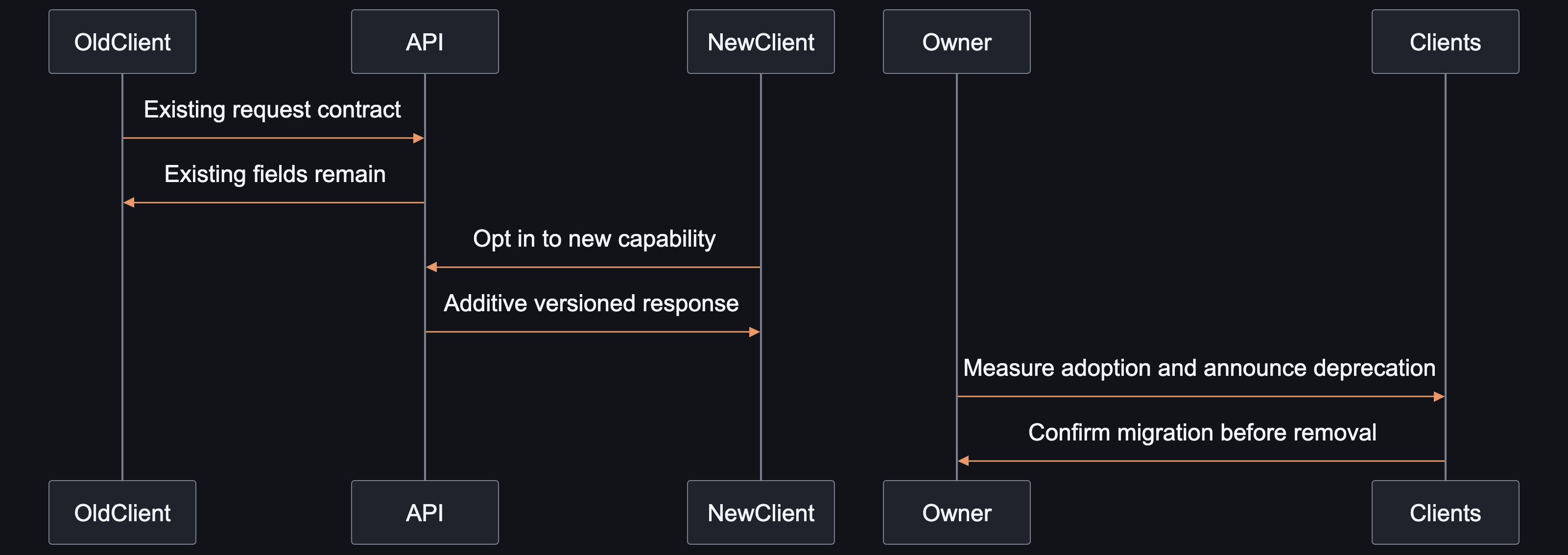
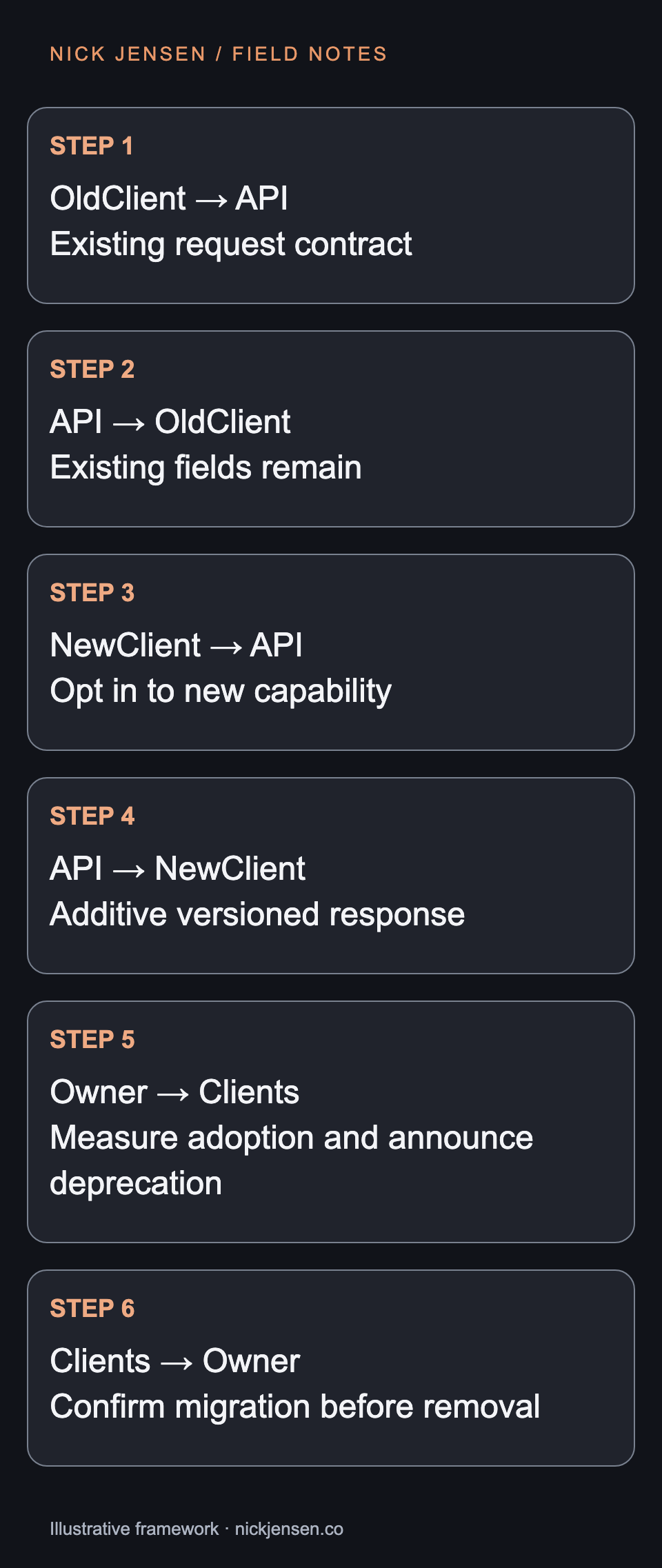
Sequence: OldClient to API: existing request contract; API to OldClient: existing fields remain; NewClient to API: opt in to new capability; API to NewClient: additive versioned response; Owner to Clients: measure adoption and announce deprecation; Clients to Owner: confirm migration before removal. Keep old and new clients working during an explicit transition; confirm adoption before removing the earlier contract.
Sequence the transition
Introduce the capability behind an explicit contract and keep the existing behavior while consumers migrate. Identify the owner of every important client, including scheduled jobs that are easy to miss. Record adoption evidence before scheduling removal. An unused code path in the server does not establish that no external client depends on it. The first figure shows this overlap. It is a reference sequence, not a claim that version numbers automatically create compatibility. Changed defaults, authorization rules, and error semantics can break a client without changing the response shape.
The compatibility checklist
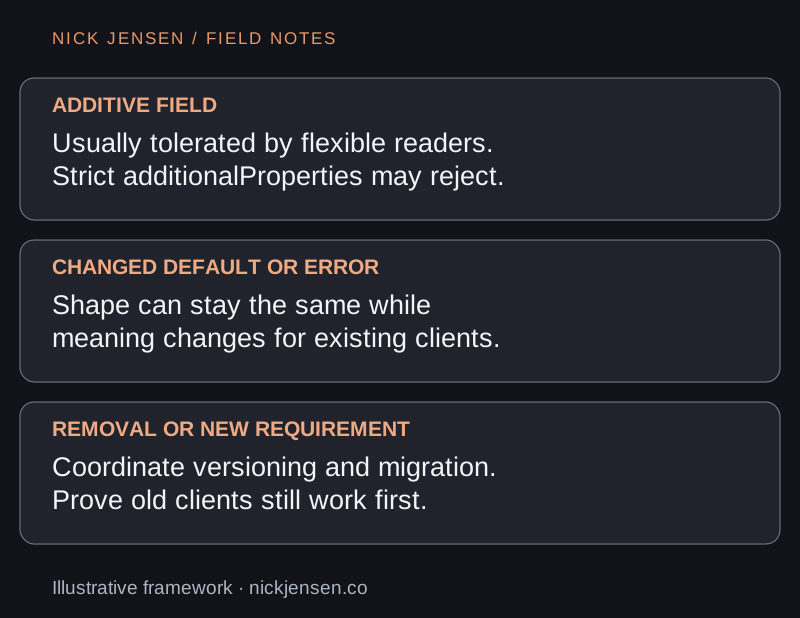
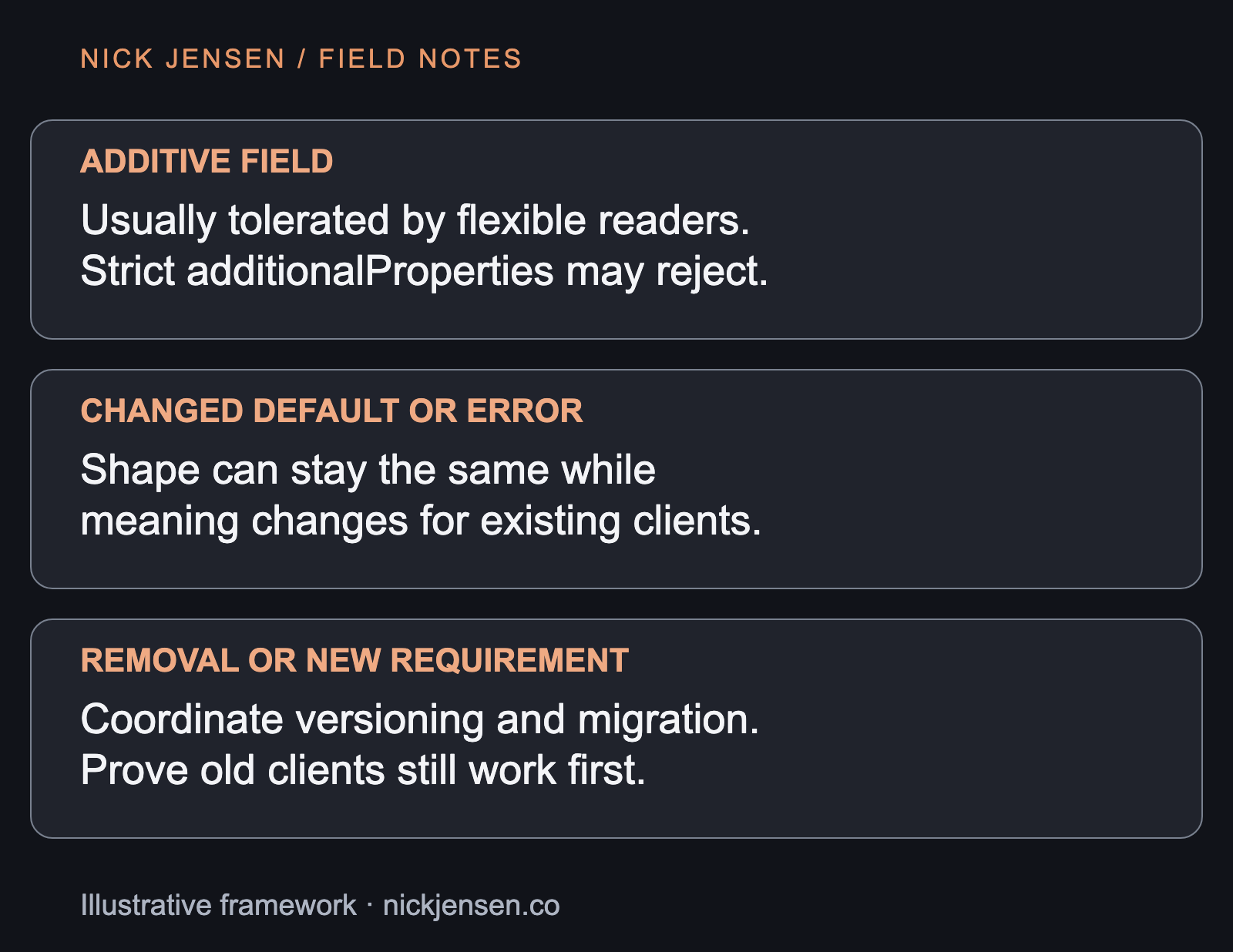
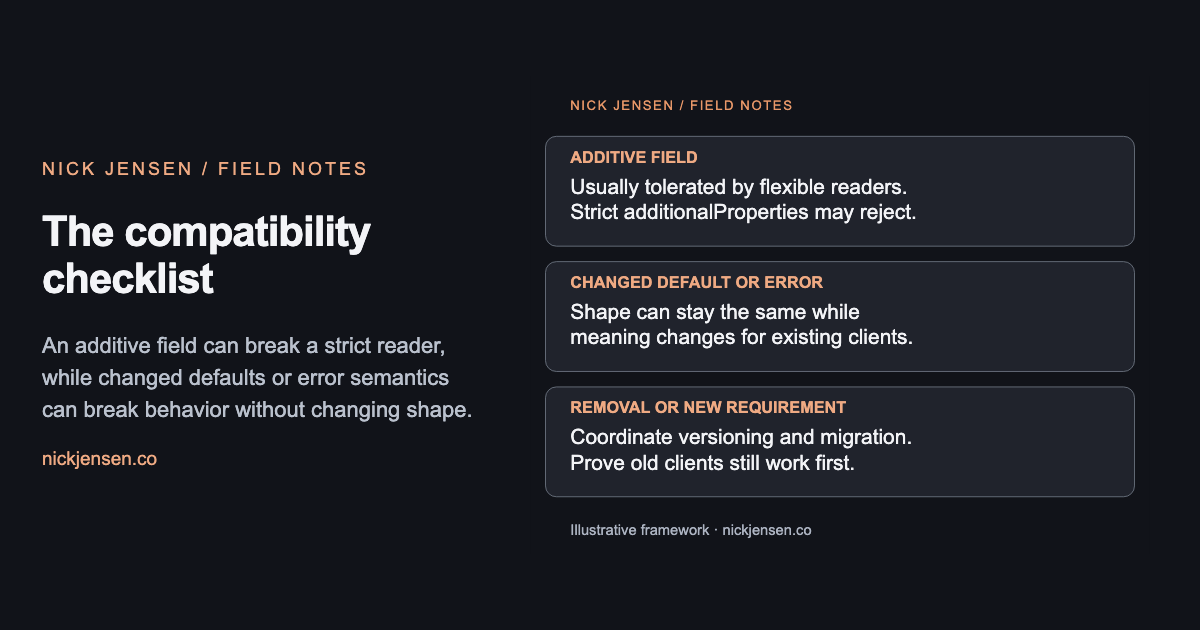
An additive field can break a strict reader, while changed defaults or error semantics can break behavior without changing shape.
Illustrative framework · Graphic by Nick JensenRead the diagram as text
Additive field: Usually tolerated by flexible readers. Strict additionalProperties may reject.; Changed default or error: Shape can stay the same while meaning changes for existing clients.; Removal or new requirement: Coordinate versioning and migration. Prove old clients still work first. An additive field can break a strict reader, while changed defaults or error semantics can break behavior without changing shape.
1 const oldOrder = { id: 'order-1', status: 'pending' } 2 const nextOrder = { ...oldOrder, estimate: null } 3 const allowed = new Set(['id', 'status']) 4 const strictAccepts = value => Object.keys(value).every(k => allowed.has(k)) 5 console.assert(strictAccepts(oldOrder) === true) 6 console.assert(strictAccepts(nextOrder) === false) 7 // A tolerant reader can select required fields; still validate their types.
Reject unsafe shortcuts
A useful failure rehearsal is a strict old schema receiving the new field. The editorial example tests demonstrate a tolerant reader and a strict reader disagreeing on that same object. Consult the JSON Schema object reference for additionalProperties behavior: https://json-schema.org/understanding-json-schema/reference/object. Do not recover by suppressing every validation failure. Decide whether the consumer should accept extensions or needs a versioned response, then prove its required fields still work. Removing validation entirely trades a visible incompatibility for less visible corruption.
Make retirement an owned decision
Keep a deprecation notice, a migration example, an escalation contact, and a rollback boundary. If the new version writes a different representation, reverting only the handler may not restore old-reader compatibility. Rehearse that data boundary before release. For the first practical step, choose one contract and assemble old-client fixtures. Connect that exercise to the event-contract article, where versioning also has to preserve the meaning of the data.