The Leverage Equation
Traditional approaches to scaling rely on linear inputs: more people, more time, more resources. But the most successful systems of the 2020s operate differently. They create compounding leverage through two key principles: AI-enhanced decision making and composable architecture.
This isn't theoretical. Organizations applying these principles report 10-50x improvements in operational efficiency, not through harder work, but through better system design. The difference is fundamental: instead of scaling effort, they scale intelligence.
Why This Matters Now
Three convergent trends make this approach essential: (1) AI capabilities have crossed the threshold from novelty to reliable tool, (2) API-first architectures have made true composability practical, and (3) the cost of coordination has dropped to near zero. Together, these create unprecedented opportunities for leverage.
AI as Context Amplifier
Beyond Automation
The first misconception about AI in systems: that it replaces human judgment. The reality is more nuanced and more powerful. AI doesn't replace judgment, it enhances context. It surfaces patterns, synthesizes information, and provides decision support at scale.
Consider a typical business scenario: responding to customer inquiries. The traditional approach scales linearly with headcount. An AI-enhanced system operates differently. It analyzes patterns across thousands of interactions, identifies common themes, suggests responses based on historical success rates, and learns from each interaction. The human makes the final call, but with dramatically better context.
The Context Cascade
Each level of the cascade creates exponential value. Better data collection enables better pattern recognition. Better patterns enable better decisions. Better decisions create better training data. The system improves itself.
| Level | Without AI | With AI |
|---|---|---|
| Data Collection | Manual, inconsistent | Automated, standardized |
| Pattern Recognition | Limited to human memory | Comprehensive analysis |
| Decision Support | Based on recent examples | Based on full historical data |
| Learning Loop | Slow, informal | Continuous, systematic |
Composability as Force Multiplier
The Building Block Principle
Composability means building systems from independent, interchangeable components. Each component does one thing well and connects cleanly with others. This isn't just good engineering, it's a leverage strategy.
When systems are composable, value compounds in unexpected ways. A component built for one use case becomes available for others. Integration patterns established once apply everywhere. Knowledge transfers across domains.
Composability in Practice
Three key patterns emerge in highly composable systems:
Single Responsibility Components
Each component has one clear job. An authentication service authenticates. A payment service processes payments. A notification service sends messages. This clarity makes components reusable and reliable.
Standard Interfaces
Components communicate through well-defined APIs. The internal implementation can change without breaking integrations. This enables continuous improvement without system-wide rewrites.
Contextual Orchestration
Higher-level systems combine components intelligently based on context. The same components arrange differently for different use cases. This is where AI and composability intersect most powerfully.
Creating Compounding Systems
The Flywheel
When AI and composability work together, they create a self-reinforcing cycle. Better components enable more intelligent orchestration. More intelligent orchestration generates better training data. Better training data improves AI capabilities. Improved AI enables better components.
This flywheel accelerates over time. Early gains are modest. But each rotation adds momentum. Systems that harness this effect separate from those that don't, not linearly, but exponentially.
Six Principles for Compound Growth
Start with Data Capture
You can't improve what you don't measure. Every system interaction should generate structured data about what happened and why.
Build Learning Loops
Data alone isn't enough. Systems need mechanisms to learn from data and apply those lessons. This is where AI integration becomes critical.
Optimize for Recombination
Design components to be mixed and matched. The value isn't in any single component, it's in the combinations they enable.
Reduce Integration Friction
Every hour spent integrating components is an hour not spent creating value. Standard interfaces and clear contracts are investments that pay compound returns.
Instrument Everything
Understanding system behavior at a granular level enables intelligent optimization. What gets measured gets improved.
Plan for Evolution
Today's optimal configuration will be suboptimal tomorrow. Systems must be designed to evolve without breaking.
From Theory to Practice
Starting Your Leverage Journey
The principles in this playbook don't require massive upfront investment. They require a shift in thinking about how systems should work. Start small, prove value, and expand.
Audit Current Systems
Where are you doing repetitive work that could be systematized? Where are you making decisions without full context? These are leverage opportunities.
Identify High-Value Components
What capabilities do you need frequently? These should become reusable components. Focus on clean interfaces and single responsibilities.
Build Intelligence Layers
Start adding AI where context matters most. Customer support, content creation, and data analysis are often high-impact starting points.
Establish Feedback Loops
Create mechanisms to capture what works and what doesn't. This data becomes the foundation for continuous improvement.
The Exponential Opportunity
We're at an inflection point. The tools for building leveraged systems are more accessible than ever. AI capabilities continue to improve. APIs connect everything. The cost of experimentation has dropped to near zero.
Separate decision authority from execution
Use one bounded job as the example
Imagine a system that drafts a weekly operational summary from approved read-only sources. Its control plane decides which sources are permitted, the job budget, the output destination, and whether publication needs approval. Its execution plane performs the bounded reads and produces a candidate artifact. This is an illustrative architecture, not a report of production reliability. The distinction prevents a worker from expanding its own authority when a task becomes difficult. A missing permission should become an explicit unresolved state rather than a prompt to search for more powerful credentials.
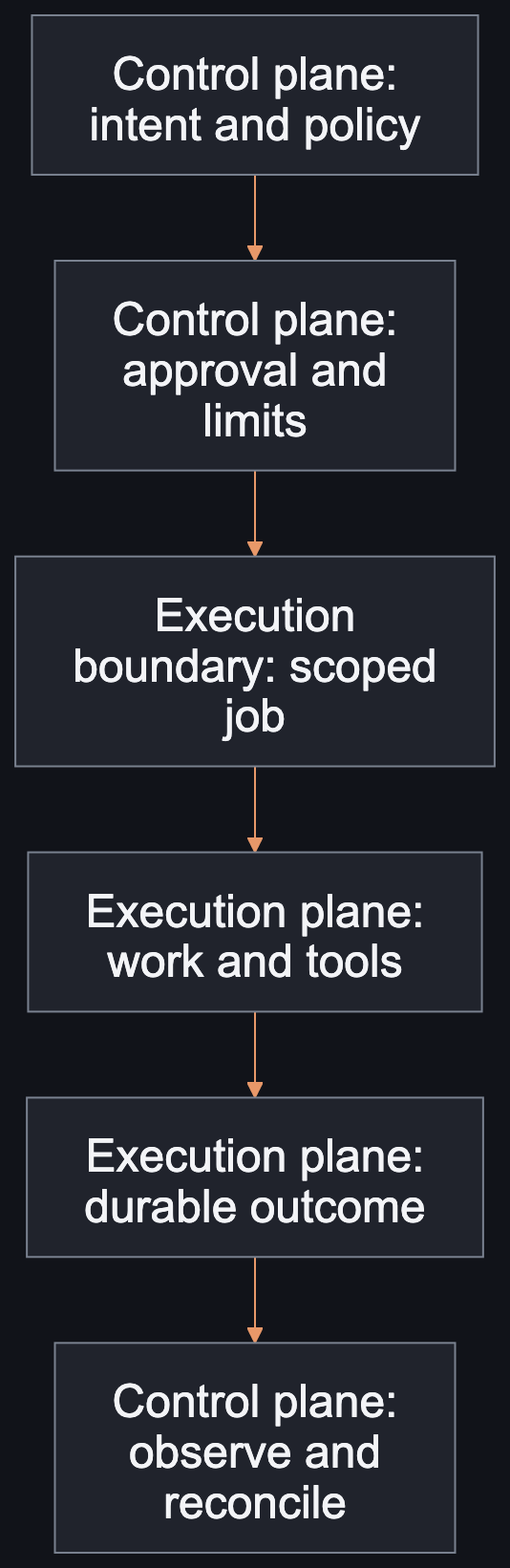
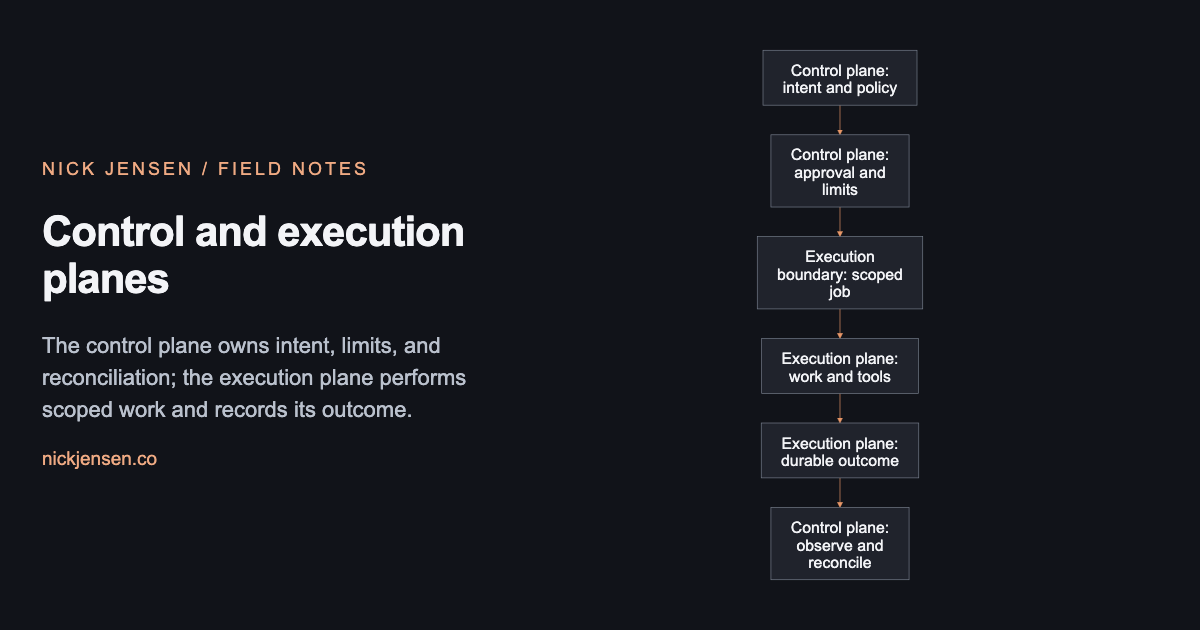
Control and execution planes
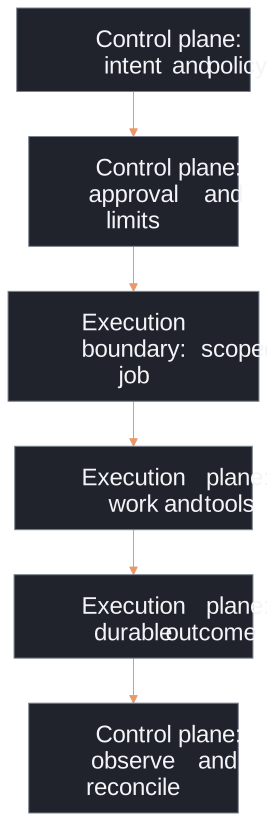
The control plane owns intent, limits, and reconciliation; the execution plane performs scoped work and records its outcome.
Illustrative framework · Graphic by Nick JensenRead the diagram as text
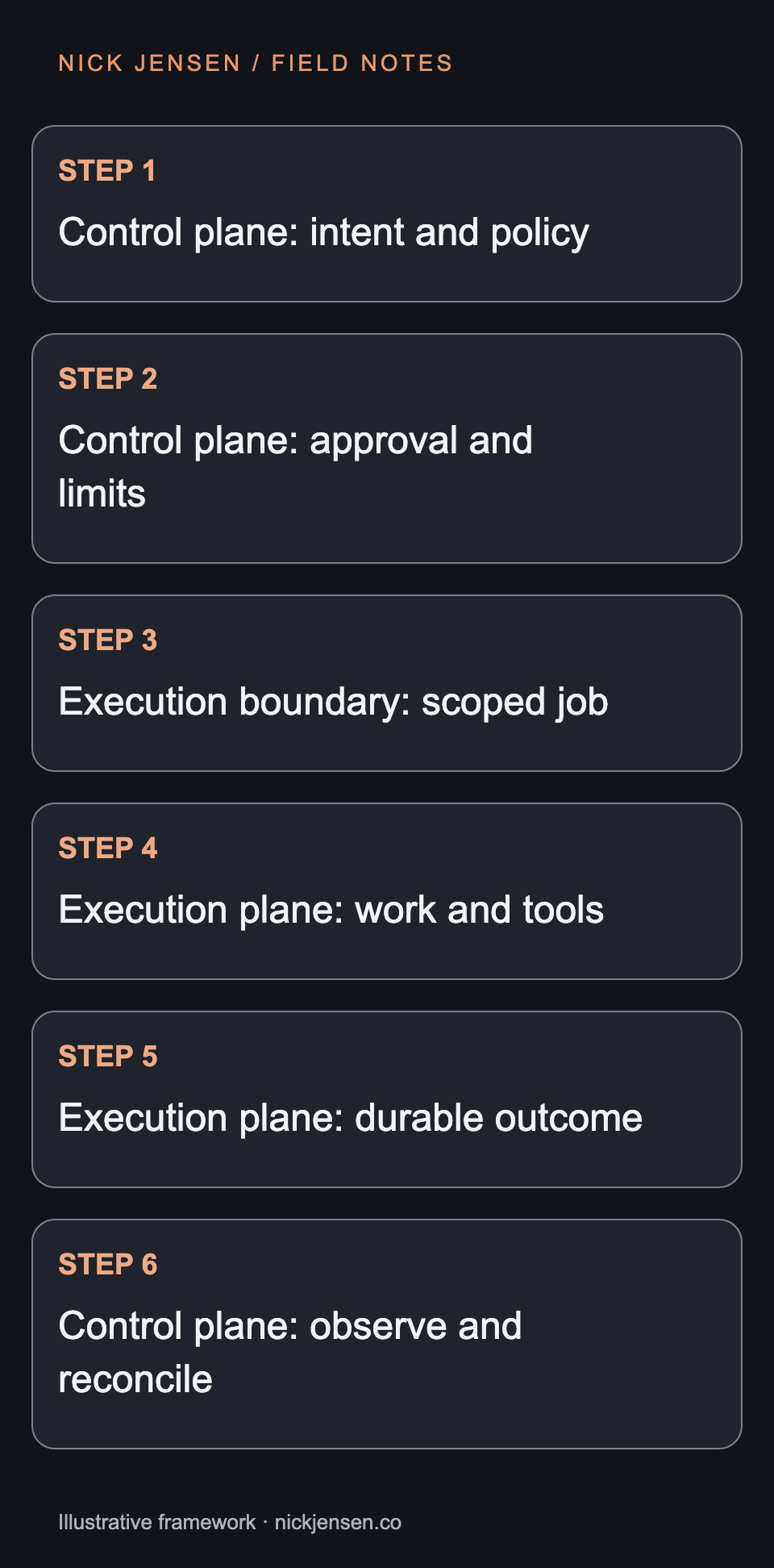
Flow from control plane: intent and policy, then control plane: approval and limits, then execution boundary: scoped job, then execution plane: work and tools, then execution plane: durable outcome, then control plane: observe and reconcile. The control plane owns intent, limits, and reconciliation; the execution plane performs scoped work and records its outcome.
Carry identity across the boundary
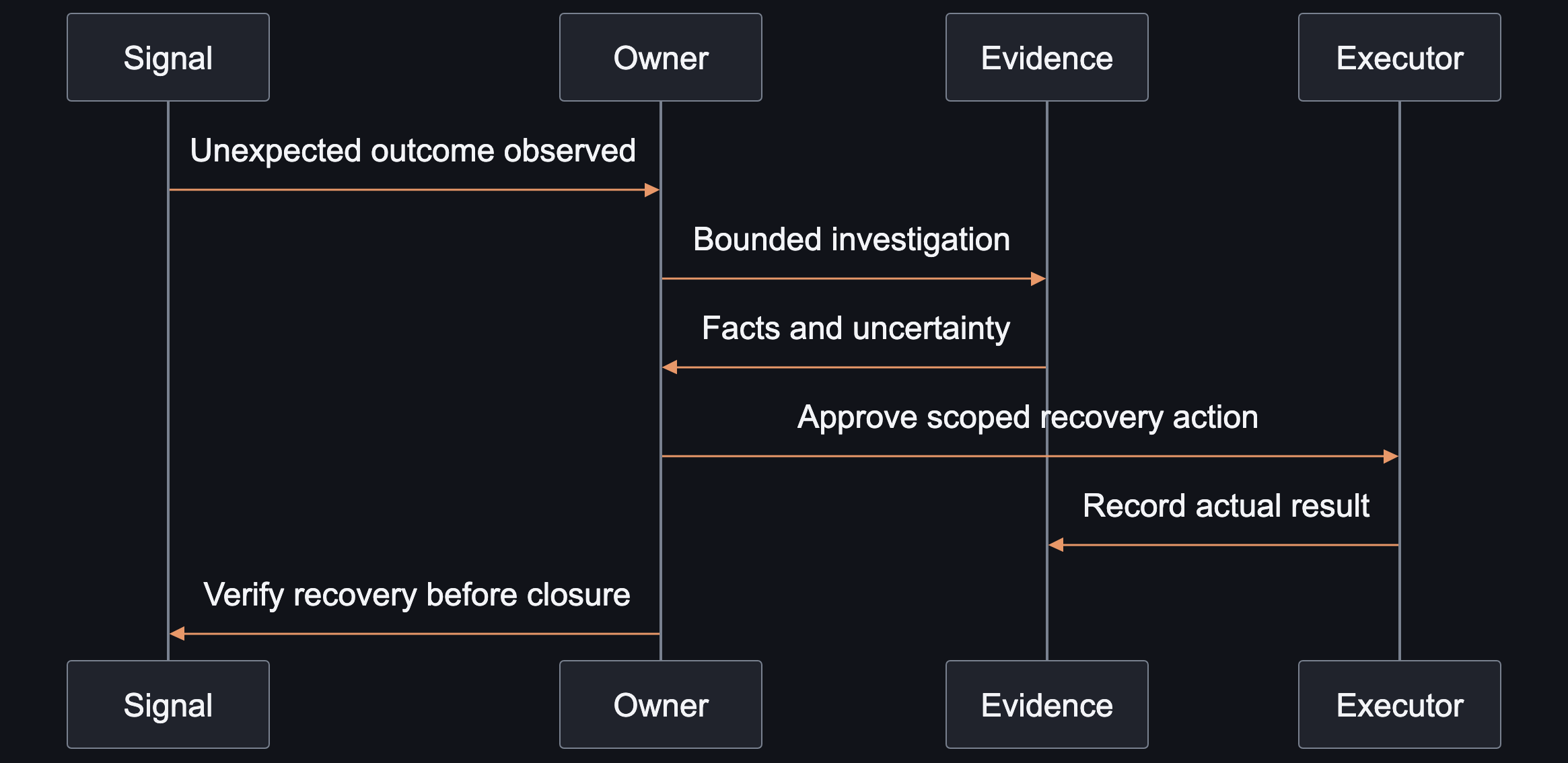
Give the job a stable identity and record the input revision, approved scope, execution result, and decision owner. If a worker retries, it should resume or safely repeat the same bounded job. Publication remains a separate effect tied to the exact approved artifact. The architecture figure separates intent and limits from tools and outcomes. The sequence figure shows an operator responding to an unexpected result. Neither requires a complicated orchestration platform; a small system can represent the same boundaries with a durable record and a clear state transition.
When feedback becomes a decision
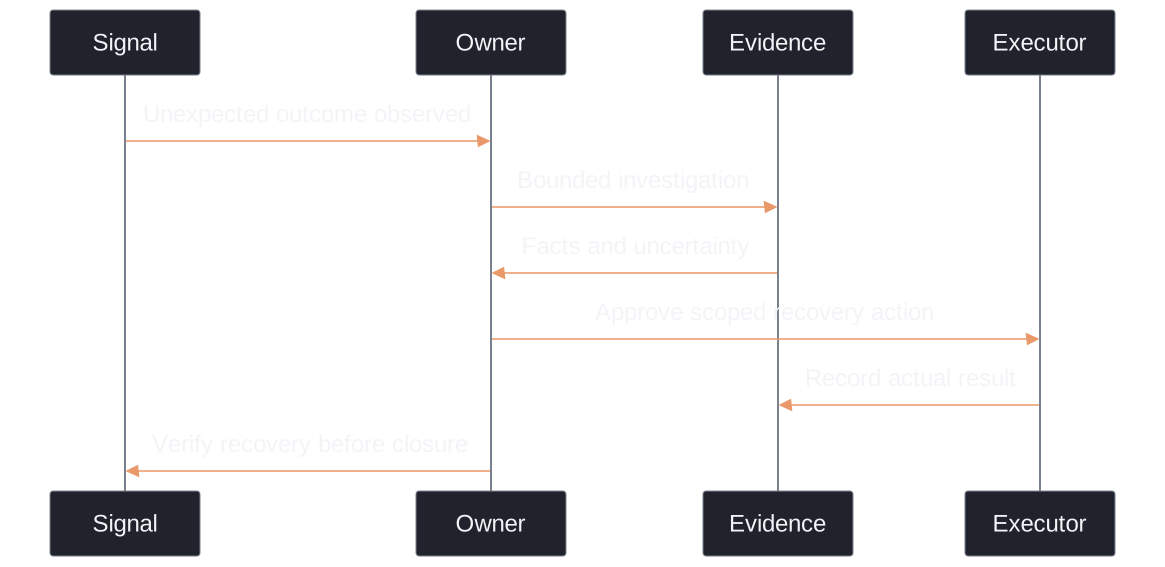
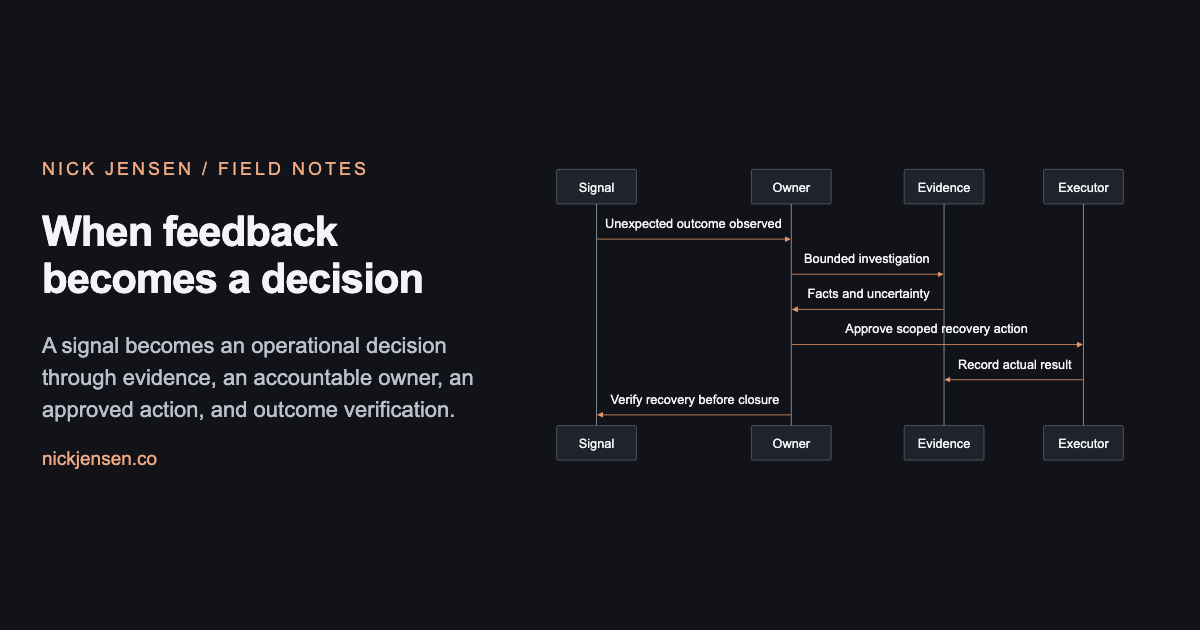
A signal becomes an operational decision through evidence, an accountable owner, an approved action, and outcome verification.
Illustrative framework · Graphic by Nick JensenRead the diagram as text
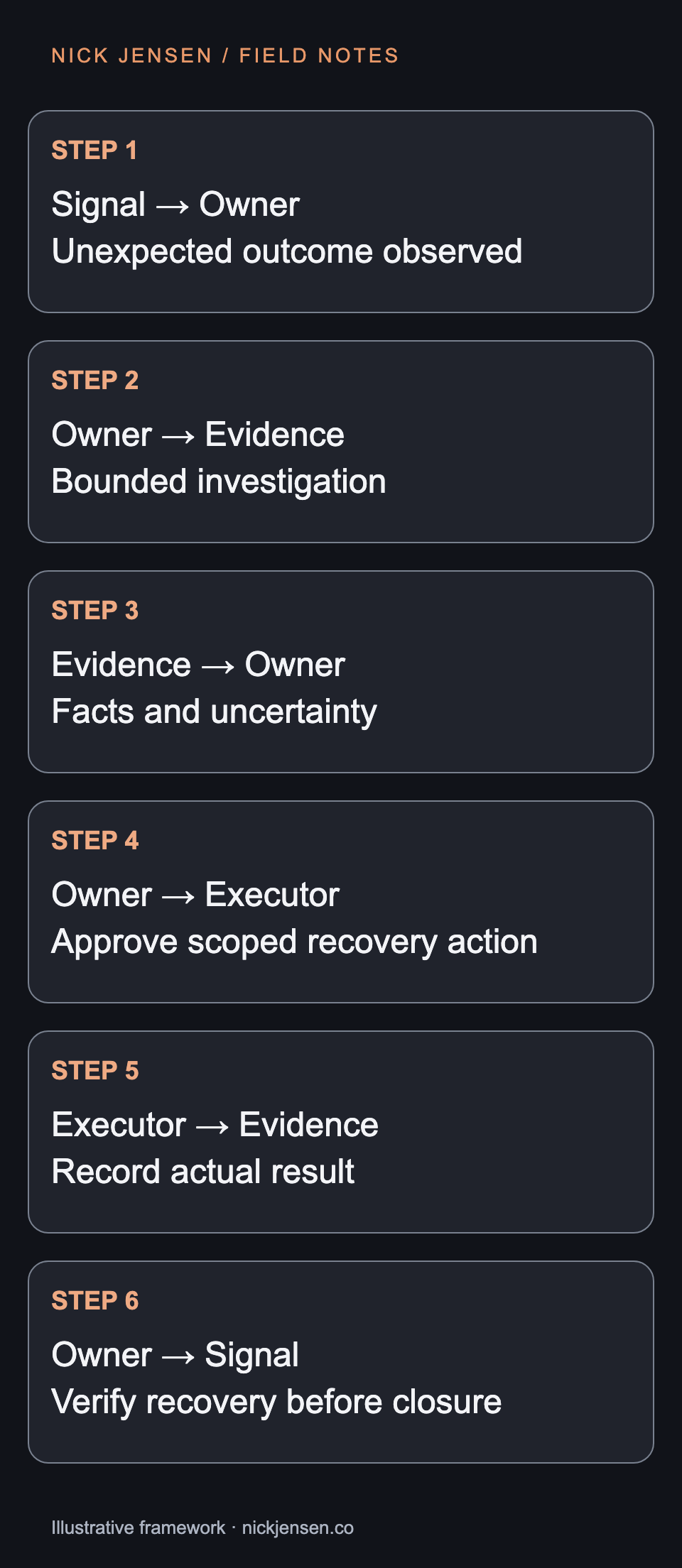
Sequence: Signal to Owner: unexpected outcome observed; Owner to Evidence: bounded investigation; Evidence to Owner: facts and uncertainty; Owner to Executor: approve scoped recovery action; Executor to Evidence: record actual result; Owner to Signal: verify recovery before closure. A signal becomes an operational decision through evidence, an accountable owner, an approved action, and outcome verification.
1 { 2 "jobId": "example-weekly-summary-01", 3 "inputRevision": "fixture-v1", 4 "allowedSources": [ 5 "synthetic-incident-notes" 6 ], 7 "dataAccess": "read-only", 8 "result": "candidate-draft", 9 "publication": "requires-exact-revision-approval", 10 "missingEvidence": "return-incomplete", 11 "retryIdentity": "jobId" 12 }
Rehearse a missing-source failure
Remove one synthetic input from a test run. The desired result is an incomplete candidate that names the missing evidence. It should not invent a plausible summary or silently use an unauthorized source. Ask the reviewer to reject the candidate, supply the correct input, and confirm that the revised artifact needs its own approval. This costs coordination and can slow a low-risk workflow. Keep deterministic formatting automated, and reserve human judgment for material claims and external effects. The point is a useful decision boundary, not approval for every keystroke.
Close the loop with evidence
After an authorized execution, compare the actual outcome with the approved intent. A successful process exit is not enough if the wrong artifact reached the destination. Record what was verified and who owns unresolved effects. Start by drawing one control-to-execution boundary in an existing workflow. Name its authority, identity, retry rule, and recovery owner. The coding-agent and human-review articles provide smaller examples you can adapt.