Case study / technical leadership
Turn scattered engineering signals into decisions.
A documented operating workflow for coordinating three teams across two products: daily briefs, PR triage, production signals, and the decisions that stay with people.
- My contribution
- Engineering leadership · first-person operating account
- Documented scope
- Three engineering teams across two products, as described in April 2026
- Evidence
- Public account and workflow diagram; no private client dashboards
The business problem: attention split across tools.
When delivery information lives across issue boards, repositories, monitoring, and email, leadership spends time collecting context before it can decide what needs attention. The published account describes that coordination problem across a platform team, a portal frontend team, and an API team.
Change the operating workflow.
| Area | Before | Documented change |
|---|---|---|
| Status collection | Switching between issue boards, pull requests, production monitoring, and email. | A scheduled brief collects those signals into a ranked set of items to review. |
| PR ownership | Manually scanning repositories to decide what needs attention. | Repeated triage groups work into ready, review, watch, and not-ready categories. |
| Escalation | Repeatedly rediscovering a blocked release or aging pull request. | Unresolved items stay visible in subsequent briefs with enough context to act. |
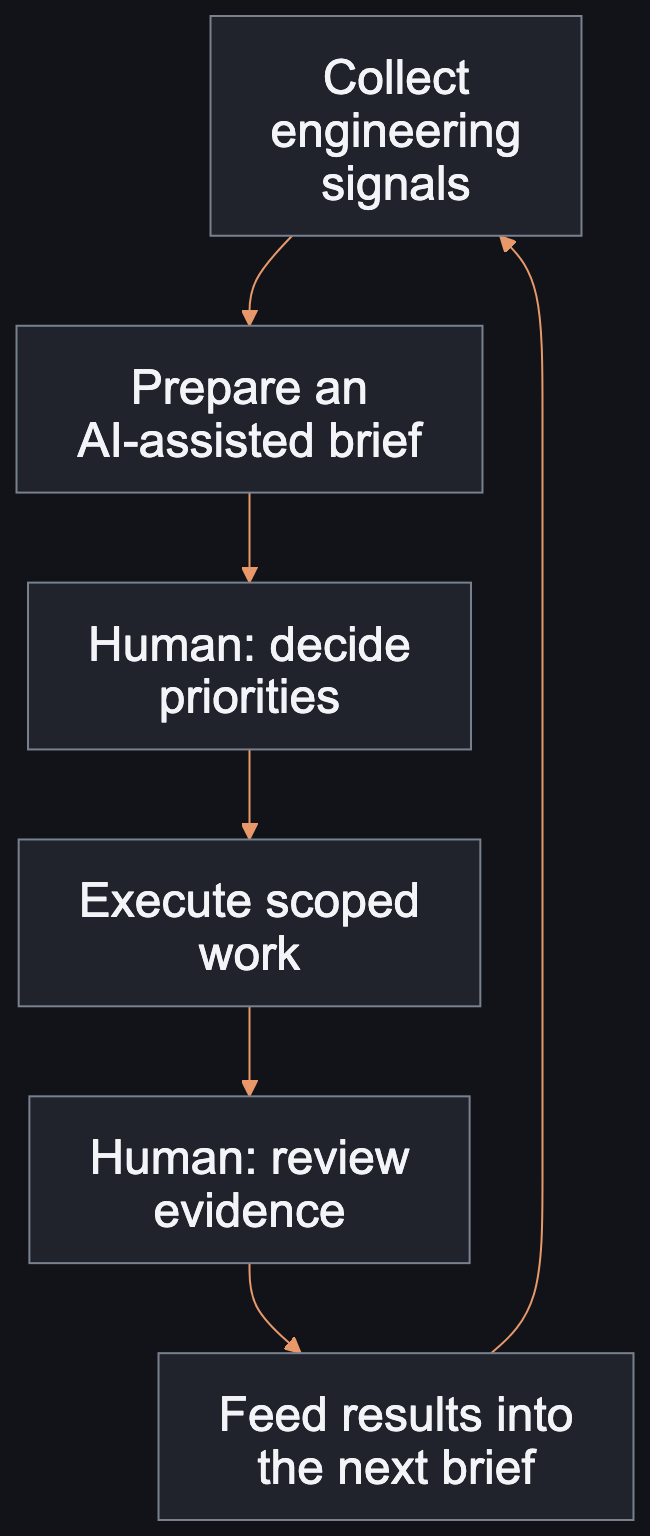
The engineering operating loop
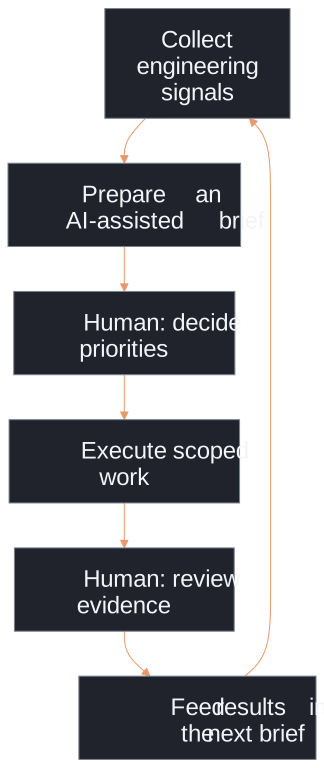
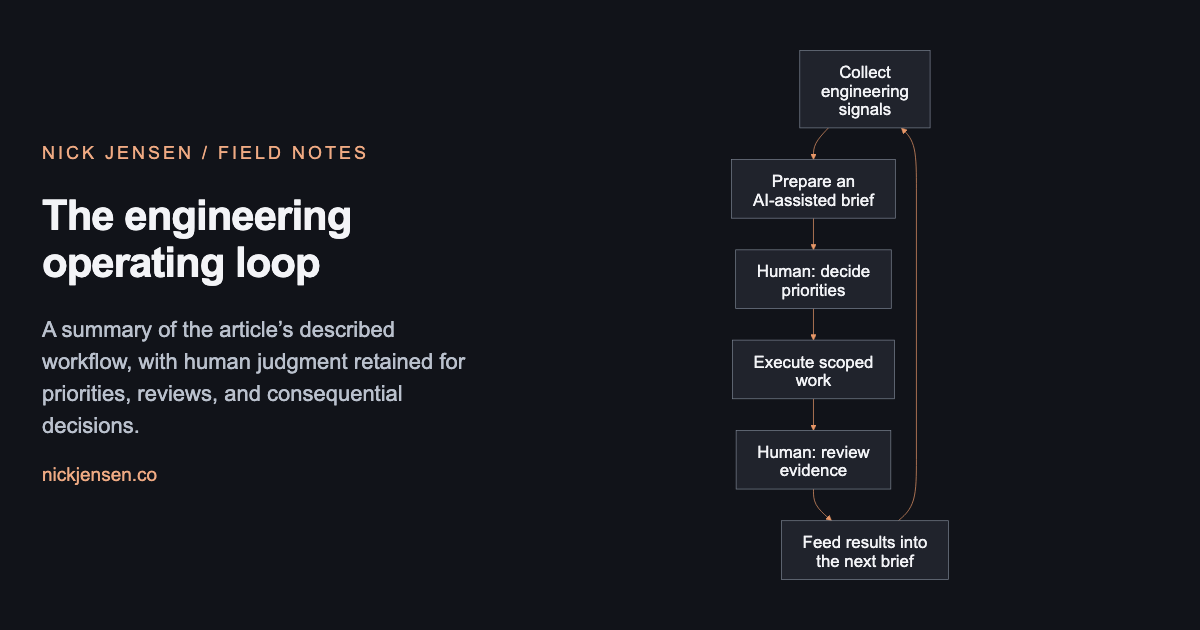
A summary of the article’s described workflow, with human judgment retained for priorities, reviews, and consequential decisions.
Based on the documented workflow · Graphic by Nick JensenRead the diagram as text
Flowchart from engineering signals to an AI-assisted brief, human priority decisions, scoped work, review, and feedback. A summary of the article’s described workflow, with human judgment retained for priorities, reviews, and consequential decisions.
The decisions behind the workflow.
Use the existing tools
The workflow reads the team's issue boards, repositories, and production signals. It assembles context around the work rather than requiring a new place to maintain status.
Make the brief actionable
A useful brief identifies a blocker, its impact, and a next decision. It is more useful than a list of activity without an owner or consequence.
Keep people accountable
The system can surface a stale PR or error cluster. It does not decide personnel questions, accept business risk, or replace the person responsible for the release.
What the evidence establishes.
The published account describes recurring briefs and PR triage delivered through Discord, with unresolved work repeatedly surfaced for attention. The demonstrated outcome is an operating workflow and clearer decision context; independently measured delivery or revenue improvements are not published.
Limits and operational ownership.
This case study summarizes Nick's April 2026 first-person account. It is not a live view of a client's systems. Private boards, customer records, credentials, and internal screenshots are excluded. Session expiry, access renewal, monitoring coverage, and model context limits still require human ownership.
Source account: How I Run 3 Engineering Teams with 1 AI Brain, published April 26, 2026. Case study updated October 20, 2026.
Put this experience to work