Field notes / Engineering Leadership
What I would do in the first 30 days as a fractional engineering leader
A proposed first-month approach to fractional engineering leadership: understand the system, review decisions, agree ownership, and establish a useful cadence.
Fractional leadership needs a clear commitment. “Help with engineering” leaves too much room for mismatched expectations. The founder may expect a roadmap, engineers may expect implementation help, and product may expect someone to settle every priority dispute.
This is a proposed first-month approach, not a report of a particular client engagement. The calendar is illustrative. A small team with one urgent decision needs a different cadence from a team operating several products.
Week one: understand the actual work
Start with the people and the path from a request to a release. Talk to the founder, product owner, and engineers. Trace a recent change through planning, implementation, review, deployment, and support.
Ask where work waits, which decisions keep returning, and who responds when something breaks. Read the code around one meaningful product path. A diagram of the intended architecture is useful, but it is not evidence of how changes actually move.
The first output should be a short account of the constraints and open questions. Avoid turning initial impressions into a sweeping reorganization proposal.
A proposed first-month cadence
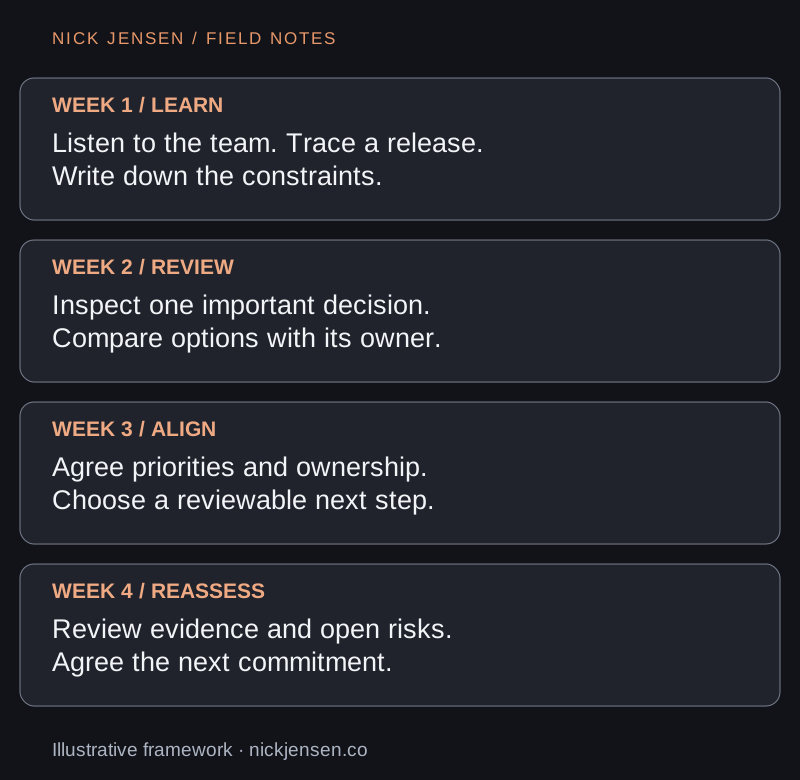
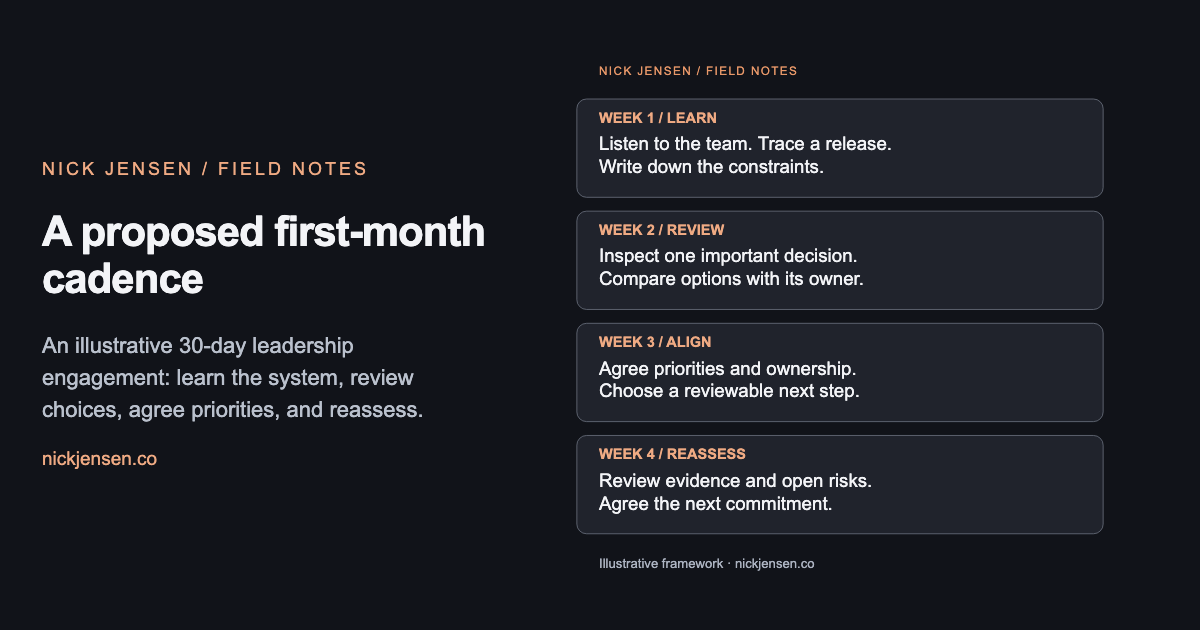
An illustrative 30-day leadership engagement: learn the system, review choices, agree priorities, and reassess.
Illustrative framework · Graphic by Nick JensenRead the diagram as text
Four stages of a proposed fractional leadership month: learn in week one, review choices in week two, agree priorities in week three, and reassess in week four. An illustrative 30-day leadership engagement: learn the system, review choices, agree priorities, and reassess.
Week two: review one consequential decision
Choose a real decision with an owner. It could concern a platform boundary, an integration, or a delivery process that is creating friction. Describe the current situation, the options, and the consequence of doing nothing.
Include the engineers closest to the implementation. Ask what evidence would change the recommendation. Distinguish a reversible experiment from a commitment that creates ongoing migration or operational work.
A useful decision record does not need to be long. It needs enough context for someone who was not in the meeting to understand why the team chose the approach. The architecture decision record article explains the value of making those choices inspectable.
Week three: agree priorities and decision ownership
The next output is a smaller set of priorities with owners and review points. That requires a conversation about tradeoffs. A list in which everything remains urgent is not a technical direction.
Make decision ownership explicit
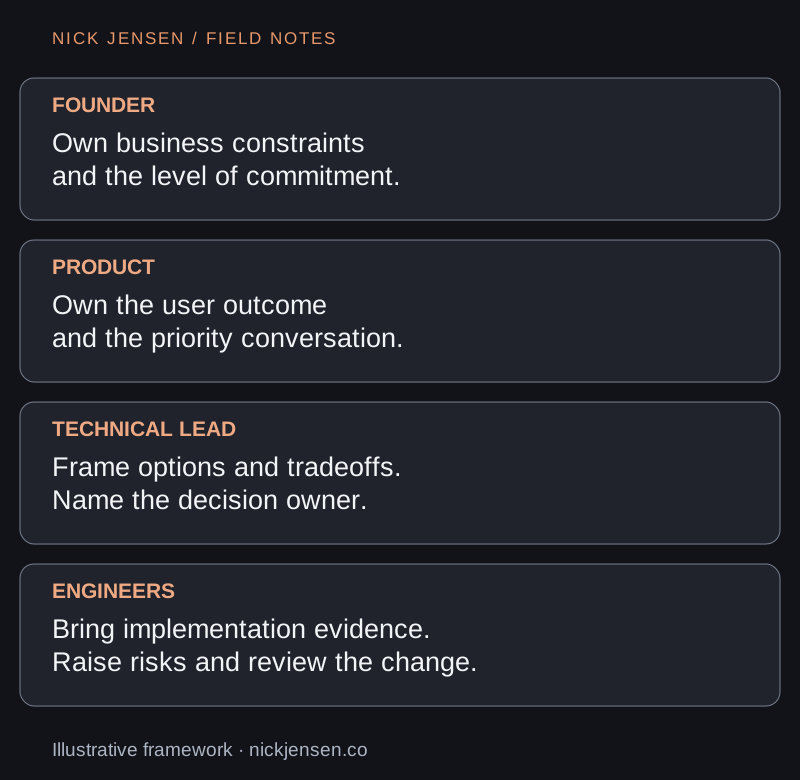
A suggested decision pattern, to be agreed with the actual team rather than imposed as a universal org chart.
Illustrative framework · Graphic by Nick JensenRead the diagram as text
Role cards assigning business constraints to the founder, user outcomes to product, technical tradeoffs to the technical lead, and implementation evidence to engineers. A suggested decision pattern, to be agreed with the actual team rather than imposed as a universal org chart.
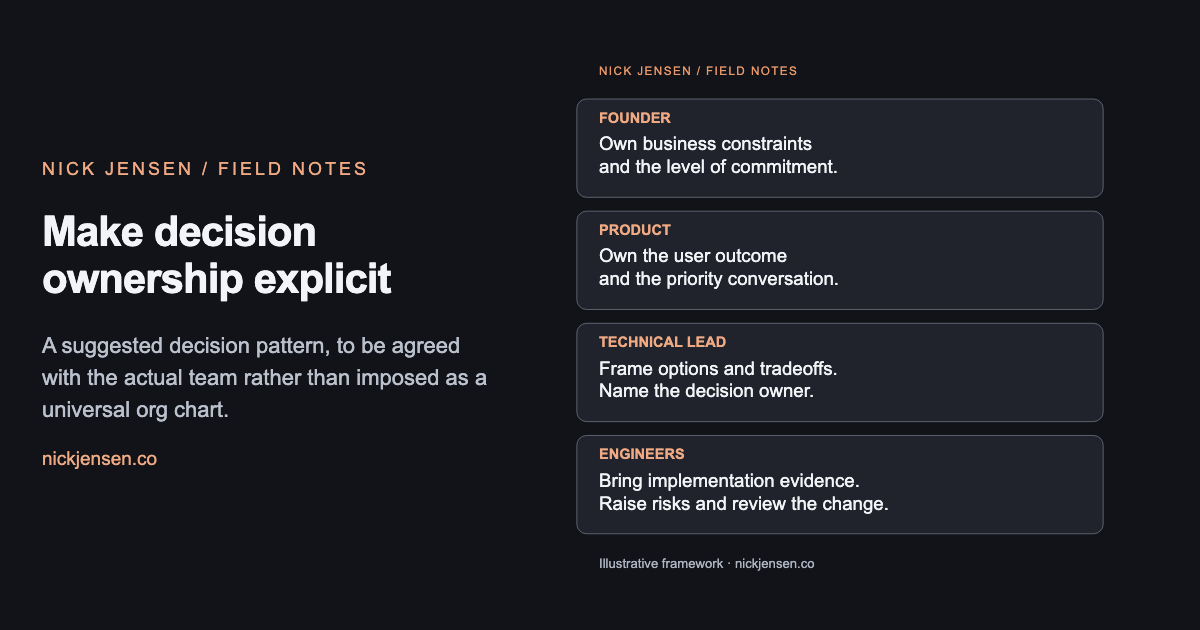
The responsibilities in this graphic are a suggested pattern, not a universal org chart. In a small company, one person may hold several roles. The point is to make the responsibility explicit rather than assume the fractional leader owns every decision.
Agree what I can decide directly, what needs consultation, and what stays with the founder or existing leadership. Also agree how much hands-on implementation the engagement includes. Those boundaries make the available time usable.
Week four: review evidence and reset the commitment
Review what changed, what stayed blocked, and which assumptions turned out to be wrong. Use actual examples: an agreed decision, a released change, a clearer owner, or an unresolved dependency. Do not turn activity counts into an unsupported claim about team productivity.
Choose the next commitment based on that evidence. Sometimes the right answer is ongoing leadership support. Sometimes it is a focused build, a specialist engagement, or a permanent hire. The first month should help clarify that choice.
What the engagement needs from both sides
A fractional leader needs access to the relevant people and systems, a named counterpart, and an agreed working cadence. The team needs clear availability, response expectations, and decision boundaries in return.
Write those expectations down before starting. A review meeting cannot compensate for a responsibility that nobody actually accepted. Neither can an AI brief replace the person accountable for a business decision.
My engineering operating workflow shows one way to organize signals and recurring work. It is an example to inspect, not a process every team should copy.
If this sounds like the situation your team is in, discuss fractional leadership support. Share the team context and one decision or delivery problem that is getting stuck.
From the idea to the work
Give the team a clearer way forward.
Work through architecture, delivery habits, and the engineering decisions that are slowing your team down.