Field notes / Startup & Product
A handoff your next engineer can actually use
Make operational ownership and maintainability part of a product delivery.
A handoff is successful when the next owner can operate the system without guessing which missing fact is dangerous. A repository link and a list of deployed services are useful inputs. They are not the whole transfer of responsibility.
Imagine a small booking application moving from a contract builder to an internal team. The team needs to run it, change it, diagnose failures, recover data, and eventually replace dependencies. Use those jobs to organize the handoff rather than writing a tour of every file.
Trace one real user path
Start with selecting a slot, submitting the request, reserving the record, and showing confirmation. Name the boundary that owns each transition. If a message provider fails after the reservation commits, who investigates and how does the user see the pending state?
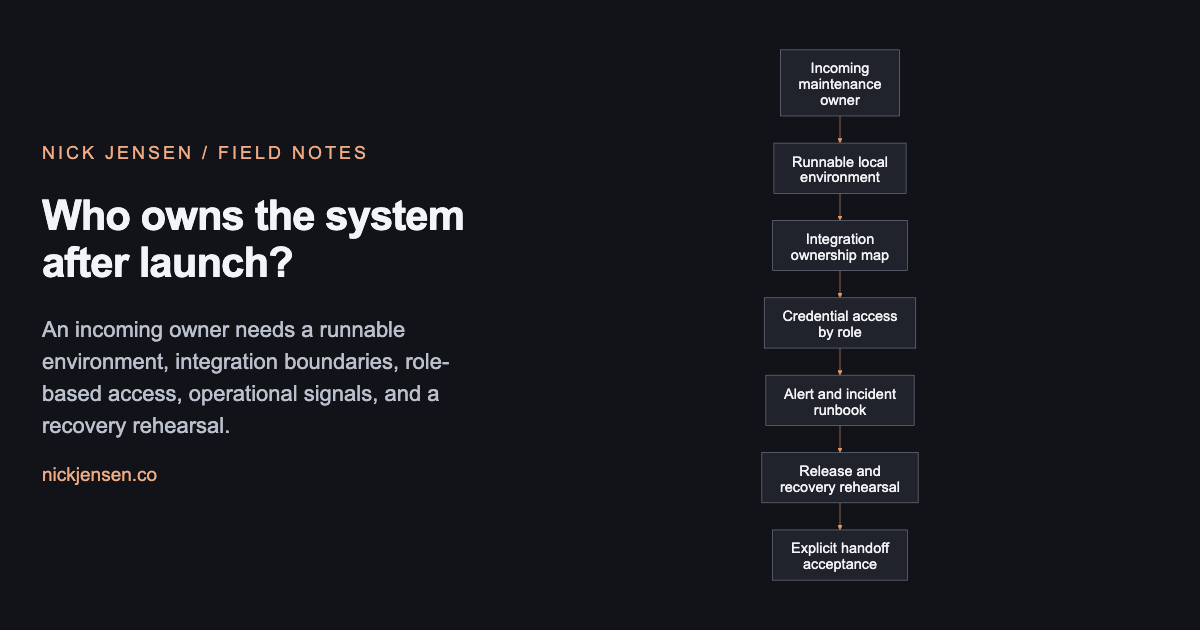
Who owns the system after launch?
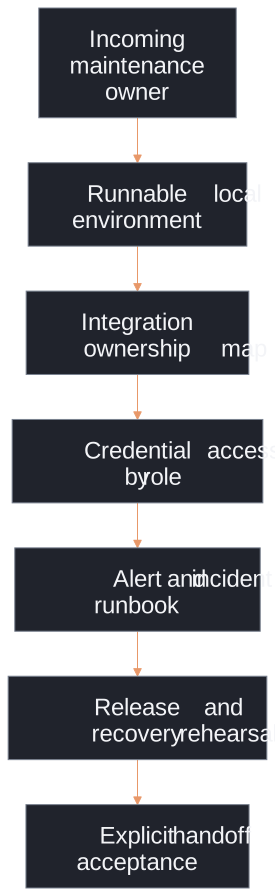
An incoming owner needs a runnable environment, integration boundaries, role-based access, operational signals, and a recovery rehearsal.
Illustrative framework · Graphic by Nick JensenRead the diagram as text
Flow from incoming maintenance owner, then runnable local environment, then integration ownership map, then credential access by role, then alert and incident runbook, then release and recovery rehearsal, then explicit handoff acceptance. An incoming owner needs a runnable environment, integration boundaries, role-based access, operational signals, and a recovery rehearsal.
The incoming owner should be able to follow a synthetic request through logs and persisted state. Use fake records and a non-production transport. A rehearsal should not send messages to customers or turn a documentation exercise into a payment attempt.
Transfer access through roles
List the access needed to operate each service and who can grant or revoke it. Store credentials in the approved secret system, not in the runbook. Document rotation and ownership transfer so access does not depend on one contractor's personal account.
A useful integration entry includes purpose, owner, configuration location, failure signal, retry behavior, and exit path. “Uses a payment provider” does not explain how a duplicate notification is handled or how a pending order is reconciled.
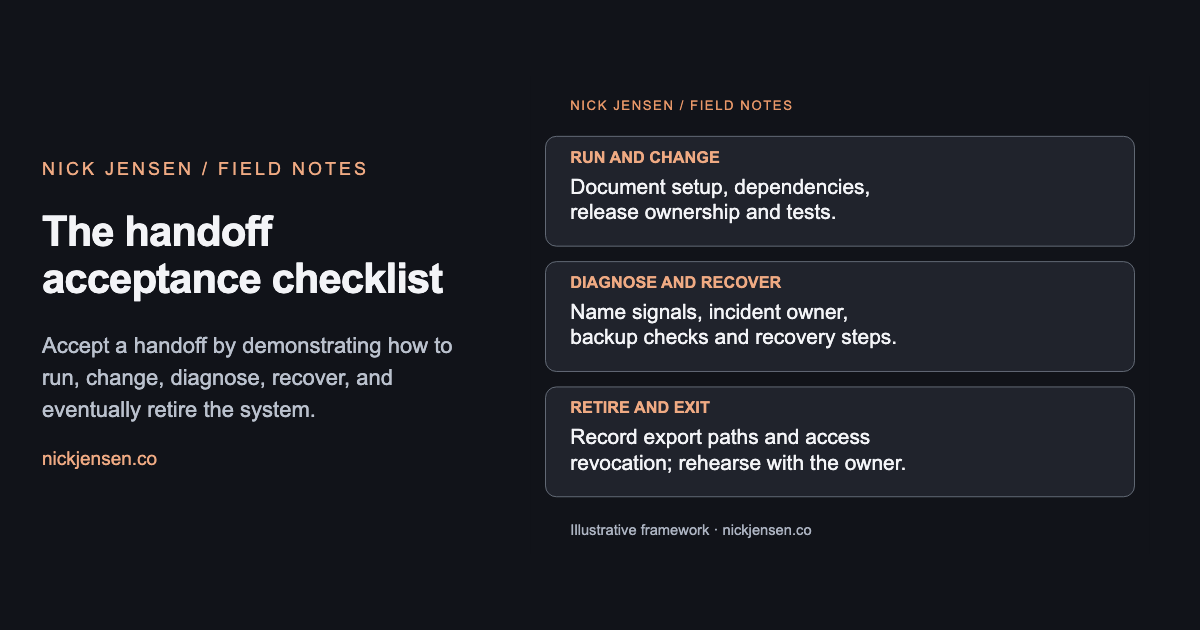
The handoff acceptance checklist
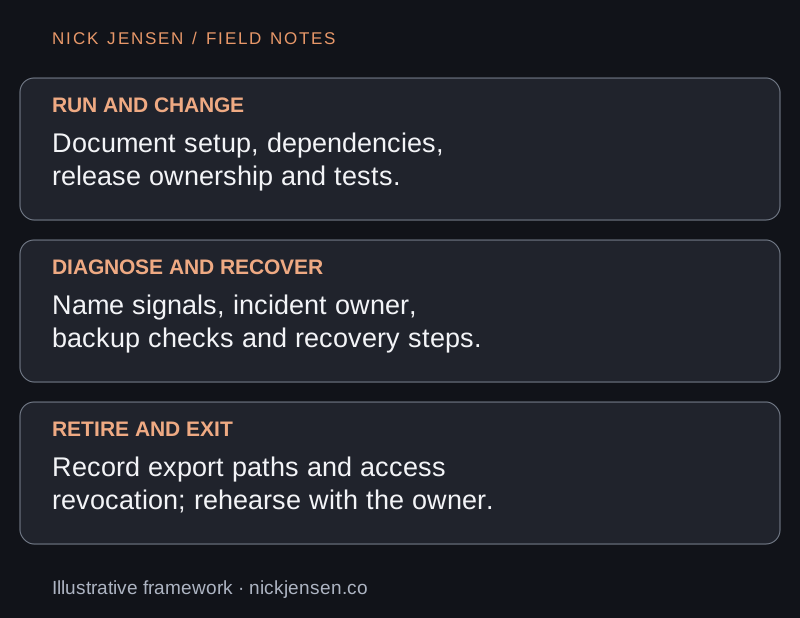
Accept a handoff by demonstrating how to run, change, diagnose, recover, and eventually retire the system.
Illustrative framework · Graphic by Nick JensenRead the diagram as text
Run and change: Document setup, dependencies, release ownership and tests.; Diagnose and recover: Name signals, incident owner, backup checks and recovery steps.; Retire and exit: Record export paths and access revocation; rehearse with the owner. Accept a handoff by demonstrating how to run, change, diagnose, recover, and eventually retire the system.
Rehearse a change and a recovery
Ask the incoming engineer to make a small reversible change, run the required checks, and explain the release and rollback steps. Then choose a controlled failure: disable a fake transport or reject a synthetic payload. Confirm the runbook leads to the right evidence and owner.
A database restore requires more care than reverting a deployment. Writes and external effects since the backup may need reconciliation. The handoff should state that boundary explicitly and identify who decides whether to pause writes, restore, or repair.
Documentation has a maintenance cost. Prefer commands that actually run, examples checked by tests, and a short list of known gaps with owners. A huge architecture document that nobody can validate is less useful than a small, exercised operational path.
Finish with explicit acceptance: what the team demonstrated, what remains unresolved, and who owns the next action. Read the onboarding guide for a first-change rehearsal and migration cutovers for data boundaries. If you need someone to build with the eventual maintenance team in mind, discuss a contract build.
From the idea to the work
Make the workflow useful in a real product.
Bring a product idea, an internal tool, or an AI-assisted workflow that needs a working implementation.